
5 Common Couples Communication Mistakes (And How to Fix Them)

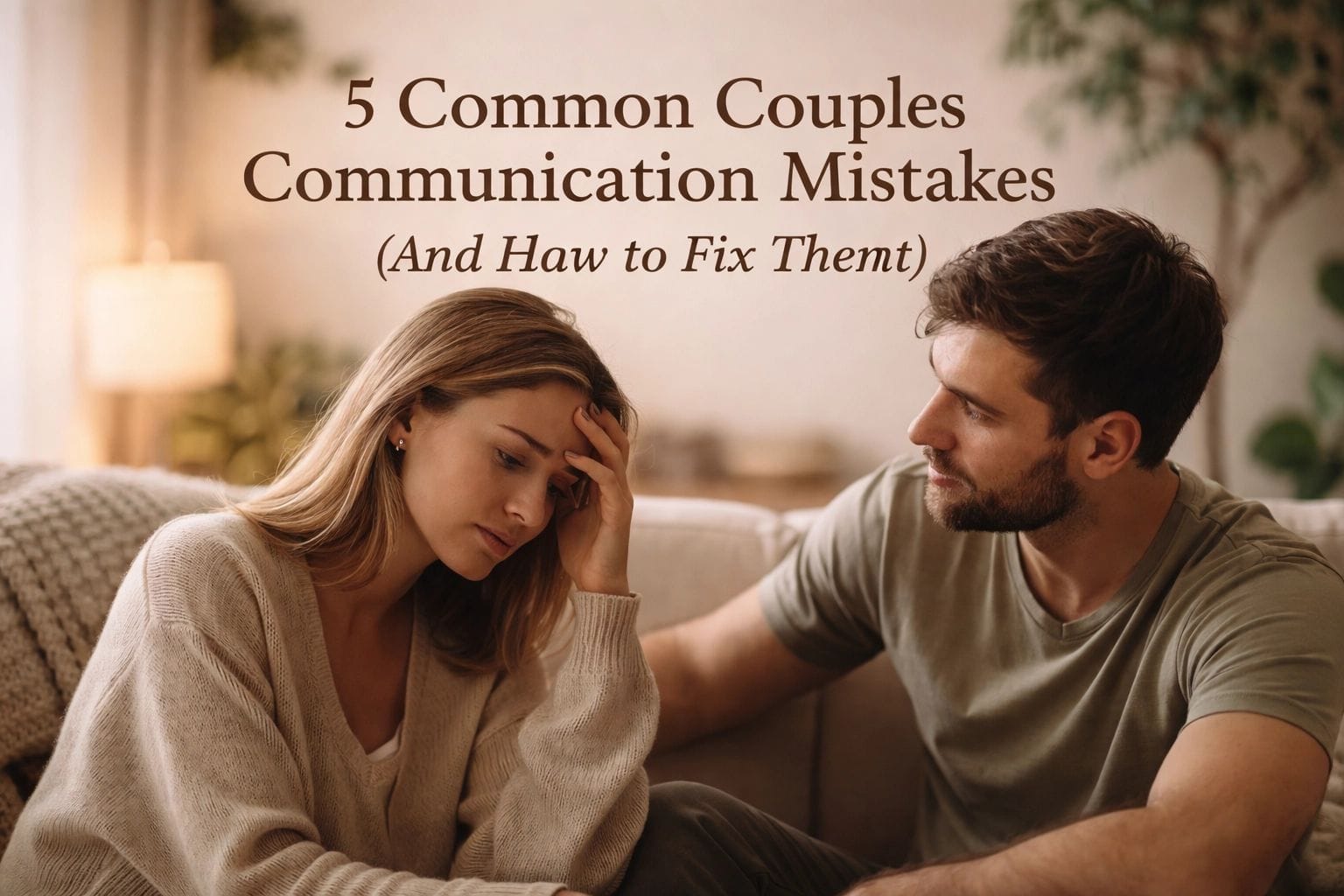
Every couple argues. That’s not the problem. The problem is how most couples argue.
Research consistently shows that the quality of communication between partners is one of the strongest predictors of relationship satisfaction and longevity. Yet most of us were never taught how to communicate effectively with a romantic partner. We learned by watching our parents, absorbing messages from movies and TV, and figuring it out through trial and error.
The result? Most couples fall into the same communication traps over and over again: patterns that create distance, resentment, and frustration instead of connection and understanding.
The good news is that communication is a skill. And like any skill, it can be learned, practiced, and im- proved. Below, we break down five of the most common communication mistakes couples make: and provide simple, actionable fixes for each one.
Mistake #1: The Blame Game
You know how this one goes. A conversation starts about dishes in the sink, and before you know it, someone says, “You never help around here” or “You always make everything about yourself.”
The Blame Game happens when we frame our frustrations as accusations. Instead of expressing how we feel, we point fingers. Instead of inviting our partner into a conversation, we put them on the de- fensive.
Here’s the thing: blame feels good in the moment. It lets us discharge our frustration and positions us as the “right” one in the conflict. But it almost never leads to resolution. When your partner feels at-
tacked, their natural response is to defend themselves: or attack back. The original issue gets lost in the crossfire.
The Fix: Use “I” Statements
“I” statements are a foundational tool in couples communication. They shift the focus from what your partner did wrong to how you feel about the situation.
Instead of saying, “You never listen to me,” try: “I feel unheard when I’m talking and you’re on your phone.”
Instead of, “You’re so inconsiderate,” try: “I felt hurt when my needs weren’t considered in that deci- sion.”
This isn’t about sugarcoating or being passive. It’s about owning your emotional experience while giving your partner a chance to respond without feeling attacked. It opens the door for dialogue in- stead of slamming it shut.
Mistake #2: Mind Reading
Many couples operate under an unspoken assumption: If you really loved me, you’d just know what I need.
This is the Mind Reading trap. It’s the expectation that your partner should be able to intuit your feel- ings, desires, and needs without you having to express them directly. And when they inevitably fail to read your mind? Disappointment. Resentment. A growing sense that maybe they don’t care as much as you thought.
The truth is, no one can read minds: no matter how much they love you. Expecting your partner to “just know” sets both of you up for failure.
The Fix: Practice Direct Communication
Be specific about what you need. Instead of hoping your partner notices you’ve had a hard day, tell them: “I had a really rough day. I could use some extra support tonight.”
Instead of silently stewing because they didn’t plan anything for your anniversary, say ahead of time: “Celebrating our anniversary is really important to me. Can we make plans together?”
Direct communication can feel vulnerable. It requires you to name your needs out loud, which can be uncomfortable. But clarity is kindness: for both you and your partner.
Mistake #3: The Silent Treatment
When conflict feels overwhelming, some people shut down completely. They stop talking. They leave the room. They give one-word answers and refuse to engage.
This is commonly called “The Silent Treatment,” and while it might feel like a way to avoid making things worse, it often does the opposite. The partner on the receiving end feels punished, dismissed, and shut out. The underlying issue remains unresolved, and emotional distance grows.
Psychologist John Gottman, whose research on couples spans over four decades, identifies this pat- tern as “stonewalling”: one of the most destructive communication behaviors in relationships.
The Fix: Take a Structured Break (Not a Shutdown)
There’s a difference between shutting down and taking a break. If you’re feeling flooded: over- whelmed by emotion to the point where you can’t think clearly: it’s actually helpful to pause the con- versation. But the key is how you do it.
Try saying: “I’m feeling really overwhelmed right now. I need 20 minutes to calm down, and then I want to come back and finish this conversation.”
This communicates that you’re not abandoning the discussion: you’re just regulating your nervous system so you can engage more productively. Set a specific time to return to the conversation, and honor that commitment.
Mistake #4: Kitchen-Sinking
Ever been in an argument about one thing that suddenly becomes about everything? That’s “Kitchen- Sinking”: the practice of throwing in every grievance you’ve ever had, all at once.
It usually sounds something like: “And while we’re at it, what about that time you forgot to pick up the kids? And you never thanked me for organizing your mom’s birthday. And three years ago, you said something that really hurt me…”
Kitchen-sinking happens when small frustrations build up over time without being addressed. Eventu- ally, they all come pouring out in a single argument: making the original issue nearly impossible to resolve.
The Fix: Address Issues as They Arise
The best way to prevent kitchen-sinking is to deal with issues when they happen, not months or years later. This doesn’t mean starting a fight over every minor annoyance. It means having regular, low- stakes check-ins where both partners can share what’s on their mind.
Some couples find it helpful to schedule a weekly “relationship check-in”: a dedicated time to talk about how things are going, share appreciations, and address any small concerns before they be- come big ones.
When you’re in the middle of a disagreement, practice staying focused on the issue at hand. If other concerns come up, acknowledge them and set them aside: “That’s something I do want to talk about, but let’s finish this conversation first.”
Mistake #5: Interrupting
Interrupting seems minor, but it sends a powerful message: What I have to say is more important than what you’re saying.
Even when done with good intentions: like jumping in to clarify or agree: interrupting can make your partner feel dismissed, unheard, and frustrated. Over time, it discourages open expression and cre- ates an imbalanced dynamic in the relationship.
The Fix: Practice Active Listening
Active listening means fully focusing on your partner’s words rather than planning your response while they’re still talking. It means letting them finish completely before you speak.
Try these strategies:
- Pause before After your partner finishes speaking, wait two to three seconds before you reply. This ensures they’re truly done and gives you time to process what they said.
- Reflect back what you heard. Before sharing your perspective, paraphrase what your partner said: “So what I’m hearing is that you felt hurt when I made that decision without consulting Is that right?”
- Set ground If interrupting is a recurring issue, agree together that you’ll let each other fin- ish speaking before responding. If you catch yourself interrupting, apologize and let your partner continue.
Communication Is a Skill: And It Takes Practice
If you recognized yourself in any of these mistakes, you’re not alone. These patterns are incredibly common, and they don’t mean your relationship is doomed.
What matters is your willingness to recognize the patterns and work on them: together.
Communication is not something you either have or you don’t. It’s a skill that can be developed with awareness, practice, and patience. Some couples find it helpful to read books or attend workshops together. Others benefit from working with a professional who can help them identify their specific patterns and develop new strategies.
The key is to approach communication as a team effort. It’s not about winning arguments or being “right.” It’s about understanding each other better and building a relationship where both partners feel heard, valued, and connected.
Ready to Strengthen Your Communication?
If you and your partner are struggling to break free from unhealthy communication patterns, you don’t have to figure it out alone. At Beyond the Storm Behavioral Health, our experienced therapists specialize in couples therapy designed to help partners communicate more effectively, resolve con- flict, and rebuild connection.
Whether you’re facing a specific challenge or simply want to strengthen your relationship, we’re here to help.
Contact us today to schedule an appointment and take the first step toward better communication: and a stronger relationship.
Schedule a free 15-minute call to see if we are a good fit.

Contact Us
